


The SEO Product team at Indeed were able to get 80% of their key pages indexed by building a business case with Indexing Insight.
Indeed is the world’s #1 job site, operating in over 60 countries. To maintain its competitive edge in organic search, Indeed employs multiple teams of SEO specialists dedicated to ensuring the website ranks prominently in Google Search.
Indeed's SEO team set out to run a series of carefully designed experiments to test the impact of programmatic pages on organic search performance.
Specifically, the team wanted to understand whether creating hyper-local pages targeting zero search volume, mid-funnel keywords could drive meaningful SEO traffic to the website.
This initiative represented an entirely new section and URL path for Indeed, meaning Google would need time to establish trust in this new part of the site.
Given the experimental nature of the project, the team took a measured approach.
They started small to determine how many local pages were needed before scaling, analysing user behaviour and accepted that growth would be gradual given the low search volume nature of the target keywords.
As the experiment progressed, the team grew the number of pages faster than could build internal links and encountered a critical complication: new pages weren’t being indexed.
The data showed that while the number of unindexed pages continued to grow, the Index Coverage score remained flat.
As the experiment progressed, the team analysed the not indexed pages using Indexing Insight reports and used them to show a strong example to the dev team: pages without internal links do not get indexed.
This became a powerful, evidence-backed argument the SEO team used to demonstrate the importance of internal linking to their engineering team.
As the team scaled the number of pages, tracking index coverage rate in Indexing Insight became a key leading indicator metric. And helped identify that index coverage rates were the necessary first step before traffic and conversions could follow.
As the SEO team monitored page index status they discovered that achieving nearly 100% index coverage rate was easy at lower page volumes (typically the first 1,000 pages). But as more pages were added beyond 10,000 pages, there is always a consistent 5–10% of pages that would remain not indexed.
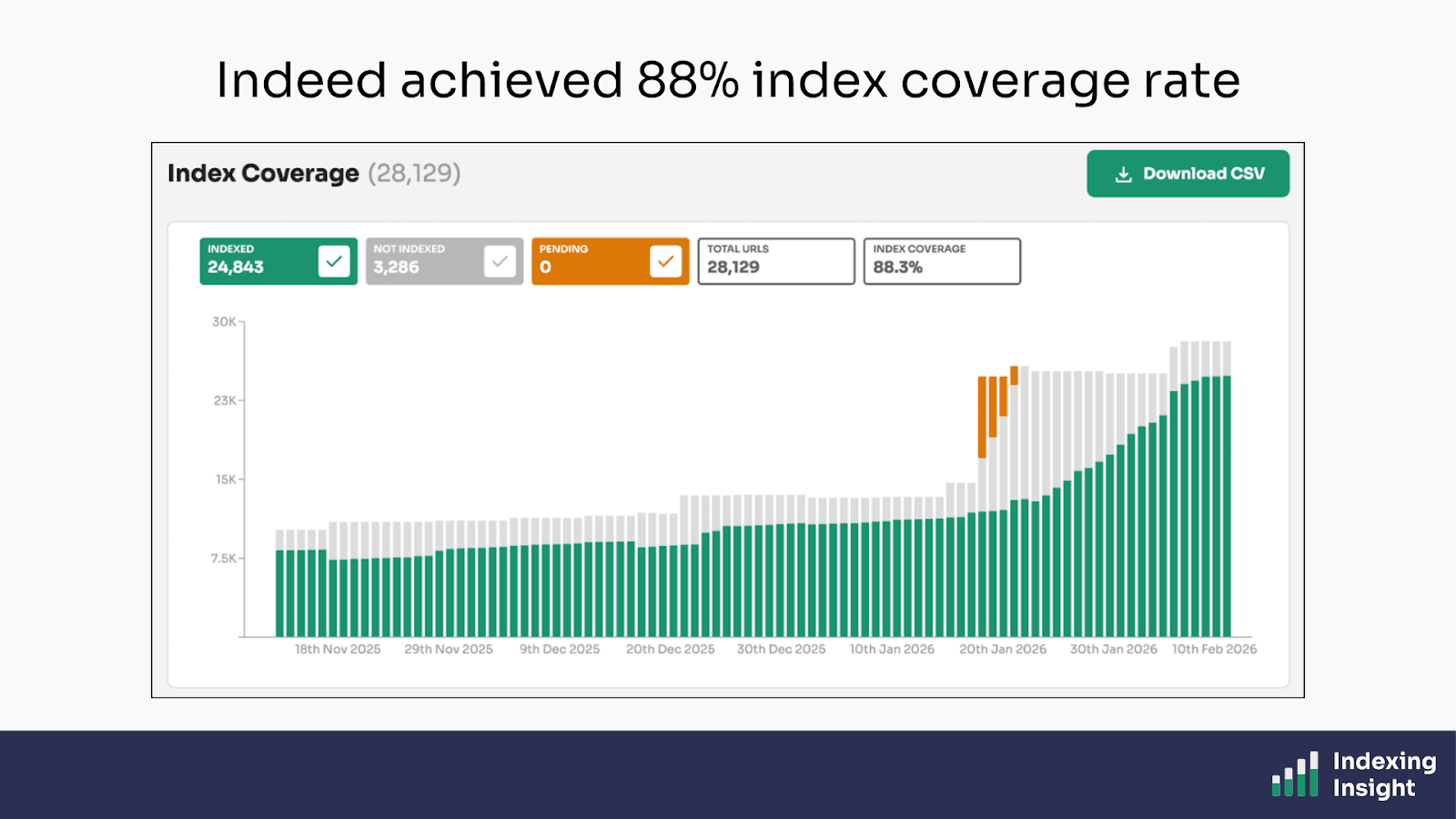
Interestingly, continuing to grow the volume of pages actually helped get more pages indexed. This suggests that there is a percentage threshold effect rather than a hard ceiling even when adding internal linking to not indexed pages.
Indeed's SEO team uses Index Coverage rate metric as an early leading indicator to help forecast success. Although clicks, conversions and impressions are still important, if a page isn’t indexed it won’t appear in search results.
“Indexing Insight has become an essential part of my workflow. I’m constantly building and launching new pages, and checking the Index Coverage rate in my daily email alerts keeps me on top of every project's performance.”
Gus Pelogia, Senior SEO & AI Product Manager

Adam Gent
SEO Product Manager and Technical SEO. I’m currently an independent consultant who works with organisations to plan, scope and execute SEO projects that drive results.
